By: Lucile Scott, amfAR
Since its inception in 2007, amfAR’s GMT Initiative has
provided financial and technical support to over 164 community organizations
working on the front lines of the epidemic to reduce the spread and impact of
HIV among gay men, other men who have sex with men, and transgender individuals
(collectively, GMT) in low- and middle-income countries. Worldwide, as
treatment access and prevention science improves, stigma and discrimination is often
the main barrier to reducing infection rates and improving access to care among
GMT. Stigma and discrimination affect every aspect and stage of
HIV treatment and prevention, from putting individuals at greater risk of engaging
in high-risk behavior that can lead to HIV infection to preventing them from
accessing health and testing services to stopping governments from targeting
them with HIV treatment and prevention efforts—though they are often one of -- if
not the-- most impacted populations in that government’s country.
 |
amfAR launches a new report providing the first-ever
comprehensive analysis of the financing and implementation
of HIV programs for GMT in Southern Africa |
The GMT Initiative provides funding and support for
localized capacity-strengthening mentoring. This helps grantee partners develop
advocacy, outreach, and training programs that target GMT, healthcare
providers, governments, and the general population to reduce the stigma and
discrimination they face. Many are doing this work in countries where
homosexuality is illegal, and HIV rates are high.
Through these programs, our grantees
-train and empower
members of the GMT community to perform peer HIV services and advocate for
their rights
-train healthcare workers about how to provide GMT with stigma and
discrimination-free care
-advocate for governments to overturn
discriminatory policies that deny GMT rights, including proper healthcare
-train the governments about how to better reach GMT with HIV messaging
once they have removed policy and legal barriers to doing so.
The organizations
also organize campaigns, performances, protests, and more that aim to educate
the general population about the GMT community. The GMT Initiative continues to
support our partner organizations as they grow and work to formalize and
evaluate their programs to improve their impact and to better understand and
pass on to others what strategies work most effectively.
In the past year, while our grantees have witnessed many
milestones in combating stigma and discrimination, they have also witnessed much backlash to
that progress. For instance, in Uganda, advocates recently succeeded in
convincing the government to include GMT in their national HIV strategy. However, in December the Parliament passed a law criminalizing “promotion of
homosexuality,” forcing those providing GMT with HIV services, including our
grantee partner Spectrum Uganda, to—at-the-least temporarily—shut those
services down. While that bill has not yet been signed into law by the
President, similar bills passed in Nigeria and Russia were. They have also
severely and, unless they are repealed, permanently curtailed our grantees’ and
other organizations’ ability to do HIV outreach among GMT, reversing years of
progress, and wasting millions of dollars in global AIDS funding.
 |
amfAR grantee-partner SOMOSGAY's new
men's health center during its launch party |
But in Armenia, as a similar law was under debate (that
has not passed), grantee partner We for Civil Equality worked with doctors, social
workers and human rights structures within the Armenian government to create a
strong medical referral system to help GMT living with HIV access
non-discriminatory care and obtain their life-saving medications. And in
Paraguay, our long-time grantee partner
SOMOSGAY opened a men’s health center created
to cater to the needs of GMT. Three grantee partner organizations in Togo
hosted a workshop for members of the media on how to improve their stigmatizing
portrayals of GMT. And in Argentina, grantee partner Asociación de Travestis,
Transexuales, Transgéneros Argentinas
(ATTTA) started shooting a documentary to
educate the general population about the discrimination and barriers to equal
rights that trans people experience each day.
 |
A film shoot for amfAR grantee-partner ATTTA's documentary
about the fight for trans rights in Argentina |
As Yves Yomb, executive director of Alternatives-Cameroun, told us in July, shortly after a string of attacks against Cameroonian LGBT activists and organizations forced Alternatives to shut down their HIV outreach operations, “We know this revolution will take time, as do all the
revolutions in the world. We don't know if we will see the
result, but we hope in 10 or 20 years, people will say the fight for gay rights
began in 2005, and thanks to them we have the rights that we have at this
moment.”
And these are just a
few of our grantee partners’ stories and successes. To read more about how they
confront and combat stigma and discrimination, please read our GMT Initiative
blog,
Grassroots.

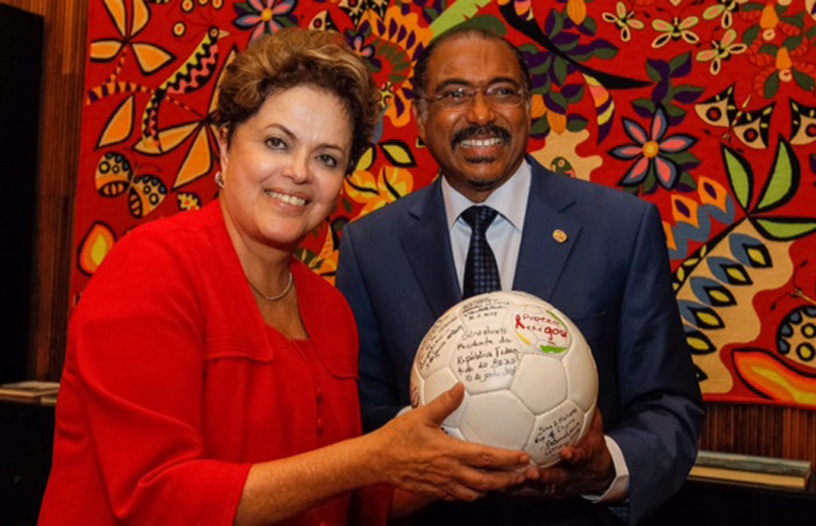
 Another organization, Grassroots
Soccer, has taken a different approach to using soccer as a means of reducing
HIV. They have built and refined a curriculum called “Skillz”, a new
approach that uses soccer exercises to help kids learn about HIV risks and
prevention. For example, in one of their
activities, called “Risk Field,” “participants dribble a soccer ball in between
cones representing HIV-related risks—multiple partners, drug/alcohol abuse,
sugar daddies, etc. If one player hits a cone, he and his teammates must
complete 3 pushups, showing how the consequences of one person’s risk can not
only affect him, but also his friends, family, and community" [4]. This is a revolutionary new way of educating kids, and allows the participants to feel more engaged in what they are learning.
Another organization, Grassroots
Soccer, has taken a different approach to using soccer as a means of reducing
HIV. They have built and refined a curriculum called “Skillz”, a new
approach that uses soccer exercises to help kids learn about HIV risks and
prevention. For example, in one of their
activities, called “Risk Field,” “participants dribble a soccer ball in between
cones representing HIV-related risks—multiple partners, drug/alcohol abuse,
sugar daddies, etc. If one player hits a cone, he and his teammates must
complete 3 pushups, showing how the consequences of one person’s risk can not
only affect him, but also his friends, family, and community" [4]. This is a revolutionary new way of educating kids, and allows the participants to feel more engaged in what they are learning. 
