Showing posts with label activism. Show all posts

Monday, January 5, 2015

Growing up with HIV in sub-Saharan Africa: One Girl’s Story


By Jennifer Abrahamson
Senior Director, Strategic Communications, ICRW

This post originally appeared on ICRW's blog.

Growing up in this day and age can be difficult for anyone. Entering adolescence in particular can be extremely complicated, as boys and girls wrestle with new responsibilities, their futures and their sexuality. In many parts of sub-Saharan Africa, the risk of HIV infection adds another layer of complexity. For girls like Joyce*, who was born HIV positive, adolescence and early adulthood can prove especially challenging.
I met Joyce in a small courtyard tucked deep within a web of unpaved roads in a slum area of a sub-Saharan capital. Shy and unassuming, she looked much younger than her 17 years. She told me that she had dreams of becoming a lawyer someday, but it soon became clear that attaining that goal would almost certainly remain out of reach.
UGA081009161

Her story is heartbreaking. And because she fears being stigmatized, she hasn’t shared the depth of her plight with her neighborhood peers. Shortly after Joyce was born, her mother succumbed to AIDS. As she got older, her father grew increasingly ill and was largely unable to work. As a result, Joyce dropped out of school because she couldn’t afford the associated fees, and at the time we met, she had stopped taking her anti-retroviral (ARVs) medication in part due to the prohibitive cost of transport required to retrieve them from the hospital. I later learned that her father passed away a few hours after our meeting.
There are legions of girls like Joyce in sub-Saharan Africa who were born HIV positive and who are now coming of age while living with the virus, and facing enormous health challenges, as well as stigma and discrimination. And adolescent girls in many countries around the world are also at high risk for acquiring HIV because of social and institutional factors, including child marriage and gender-based violence.
ETH011512420Zambia is one such country. UNICEF estimated there were at least 80,000 adolescents living with HIV in Zambia in 2009. In order to better understand the challenges adolescent girls living with HIV face as they transition into adulthood, ICRW, in partnership with public health research organization, Zambart, is conducting a first-of-its kind qualitative study in the country with support from the MAC AIDS Fund.

The encouraging growth of home-based and provider-initiated HIV testing and counselling in Zambia will likely increase the number of adolescent girls who learn they are living with HIV in upcoming years. As a result, there will likely be an increased demand for treatment, care and support services in Zambia. Despite this burgeoning demographic of young Zambians living with HIV, psychosocial support and health care services for adolescent girls is limited. This deficit is worsened by the prevalence of HIV-related stigma and discrimination, as well as gender-based prejudice that affects the daily lives of girls living with HIV.
In an effort to address this gap in services, the ICRW-Zambart study is examining the unique stigma- and gender-related obstacles girls endure while facing some of the challenges of living with HIV such as adhering to medication regimens and clinical appointments, navigating safe sexual relationships, and handling the psychosocial challenges of learning of and disclosing their status. Through participatory workshops and interviews, ICRW will identify key challenges and stigma-related concerns surrounding HIV and pinpoint areas for intervention development to support healthy transitions to adulthood for these girls.
With this information, ICRW hopes to inform national programming and policies for adolescent girls living with HIV in Zambia. Beyond that, ICRW hopes this study will garner increased attention and action to address the needs and concerns of adolescents like Joyce living with HIV around the world, with a particular focus on addressing HIV-related stigma and discrimination.
As for Joyce, today she is doing much better, although she still faces many struggles. She recently celebrated her 18th birthday, she’s back on her ARVs and her health is improving every day, and she has joined a drama-troupe with other HIV-positive youth. Although finances are tight, she also has aspirations to enrol in a hotel management training course that will give her the tools needed to support herself, stay healthy and if not reach her ultimate dream of becoming a lawyer, to blossom into adulthood.
*Joyce is not her real name. To help support her education and daily needs, please write to Erin Kelly at ekelly@icrw.org

Tuesday, September 9, 2014

New HIV Campaign: My Status is Not A Secret by Josh Robbins


This post originally appeared on Josh Robbins' Blog


Conversation-starting think tank behind “Knowing” and “Open” partner with top visual agency for new engagement platform and interview series by wanting everyone to say “my status is not a secret”


The creative collective The Advisorie Group, the peeps behind “Knowing” and “Open“, never cease to get my happy-wheels turning easily.  But, this time, the championship HIV campaign might have just been taken when they partnered with Parker Trewin (AIDS/LifeCycle participant) and the hot creative agency Column Five to launch “My Status Is Not A Secret.”
“If people are going to be motivated to get tested and, if needed, get treatment, we need to bring conversations about HIV/AIDS out of the dark and into the light,” Trewin says. After living with HIV for 10 years, Trewin only recently came out to his family as HIV-positive. He adds that, “We can each play a part, which is just one reason for me to finally tell my story—and why my status is no longer a secret.”

This year, Trewin rides in the AIDS/LifeCycle with an ambitious fundraising goal to give back to two organizations that have existed since before HIV had a name: the San Francisco AIDS Foundation and the LA Gay & Lesbian Center. To support Trewin in his efforts, the My Status Is Not A Secret site offers opportunities for visitors to help fund AIDS/LifeCycle participants.
But that’s the obvious of the new HIV campaign launched 4.2.14.
For me, I’m always interested in the “why” of things.  Maybe it’s the inherent reaction I have that dates back to my childhood, when I would always ask my parents the question: “But, why?” and they would always answer: “Because.” — driving me insane.  But, I’m curious.  So, I asked the team to answer my “why” questions. They agreed.
Here are the players chatting– Parker Trewin (Inspiration for the site), John Saint-Denis (The Advisorie Group), Ian Klein (Senior Producer, Column Five and all around cool guy) and mentions of Jason Lankow (the King guru/CEO/Co-founder of Column Five). And, well, I’m Josh Robbins– and I run a cool HIV blog.
ISJ:  Why the campaign? Why the website?
Parker:  The campaign started from an ask for the AIDS/Lifecycle – a 545-mile charity bike ride. I asked Jason My Status is Not A Secretif Column Five, who I had worked with, would donate some funds to get me on my way.  Jason said he thought it would be more powerful to donate some time. (Actually a lot of time.)  He assigned me Ian and Andrea Bravo and we investigated two reasons why I was so passionate about my efforts: getting a second chance at life and combating stigma. We thought “stigma” was the more powerful theme and what started out as a fundraising site grew into something we think is much bigger. What makes it unique are the stories, which are incredibly powerful and are told from a very personal perspective – from gay, straight, positive, negative, men, women, white, latino, african american, middle eastern. It was important to me that we explore in the widest range possible why people (and why people don’t) know their status and share their status. I was interested in not the choices people make but why people make those choices. And if we lead by example couldn’t we then help people be more empowered to make better choices? It was a way to give back.

"What makes it unique are the stories, which are incredibly powerful and are told from a very personal perspective – from gay, straight, positive, negative, men, women, white, latino, african american, middle eastern."
ISJ:  Where did the tag come from?  Who came up with it (My Status Is Not A Secret)?
Ian:  Once there was a boy and his whiteboard…no really, I was holding a brainstorm session with our copywriter Katy French and Director of Production Andrea Bravo and it was still at that point in the meeting wherein the room wasn’t quite heated up. We were still discussing things like “desired outcomes” and company mission statements—important cornerstones to be sure—but we didn’t quite know what structure we were building. At these types of meetings, I can usually be found at the whiteboard with a pen in hand. I started writing out some of the commonly shared statements one might come across in dating applications—particularly gay ones as Parker had previously shared one he didn’t like seeing: DDF UB2 (drug and disease free, you be too). He felt that this “requirement” was a result of precisely the kind of stigma we were looking to help eradicate with this campaign—the kind of stigma that precluded people from not discussing status openly. I thought, “what would be something I’d want to hear someone say in regards to their status?” “My Status Is Not A Secret.” I wrote it without saying it out loud. Nobody said anything at first. Katy, Andrea, and I all looked at it, each other, and finally said, “Yeah. This is it.”
“Yeah. This is it.”
ISJ:  Why won’t this campaign become more of the same (i.e.: similar messages to HIV campaigns already launched and already at times exhausted)?
John:  The campaign is to educate and to open hearts, not to throw out a bunch of cold facts without context.  We sought to educate through testimony, through story, and that makes it different.  Especially in that we assembled a group of such engaging and honest participants, both for the videos and for the written testimonies. I think de-stigmatizing HIV while still encouraging folks to keep themselves and their sexual partners safe can be achieved best through compassion, and I think it’s very easy to feel compassion and love for the people revealing themselves on this site.  I also think that keeping the people in your life safe isn’t just about preventing HIV transmission, it’s about fostering safety to be honest, to feel safety in support, in being taken care of and in being loved unconditionally. Is that fluffy?  I hope not.  I found out my negative status for the first time in 1987, and have tested negative over and over since, but I am quite sure that we are all living with HIV. I’ve had long time partners who are positive.  I’ve lost many friends.  I’ve learned about living in the moment and of living in courage like no other generation of gays.  We are all in this together.
"Is that fluffy?  I hope not"
Parker:  I think its the perspective and the vulnerability of those that have stepped up to share their stories.
ISJ:  Why the social element of sharing reader submissions?  Where does it all go? 
Ian:  Knowing one’s status is an act of taking responsibility for one’s body and mind. Gay or straight, positive or negative, the ability to own that knowledge is empowering. With that knowledge an individual has the choice of whether to share one’s status with others. We wanted to have a place where people of any race, gender, sexual orientation, or HIV status could go to demonstrate that power and self-confidence. At the moment, those quotes live on the My Status Is Not A Secret site as a repository for diverse thought and opinion on knowing and disclosing status. Who knows—in the future, there could be even more paths for those stories to take.
Parker: For me it’s all about sharing. This is one way people can engage and make their own statement – which is the most powerful of all.
Josh Robbins Adds to HIV Campaign
ISJ:  From the agency perspective, share the ‘creative’ process and how you hope it resonates.
Parker: We started with a lot of trust from the get go.  And I’m not the easiest client. I have a lot of opinions and it’s not easy for me to let go of control — especially control of my story. But I had a lot of faith in the team.
John:  The Advisorie Group, which is my agency that partnered with Column Five, came in late in the process, when we got to the videos.  We decided early on that this was only going to resonate if I were to personally sit with each of the interview participants, one on one in a small room and develop a relationship with each of them on film.  In the editing process we removed my voice asking the questions to make it all about them.  I hope that makes viewers feel like they are the ones interacting with the folks on the films.  Although that was the overlying creative process, each person’s interview was a very different experience.  Some talked nearly non-stop for up to an hour each.  Others had conversations with me and asked me questions about my own experience, which I loved.  Who could ask for a more satisfying creative endeavor?
Ian:  We approached the project in a similar fashion to other projects gathering inspiration, wireframing*, scaling and rescaling to budget, and many rounds of content, but always with a conscious eye toward elevating the human element and a respect toward people’s personal choices when it comes to HIV treatment and prevention efforts.  I’d enjoyed working with John Saint-Denis of The Advisorie Group before on a series of short films for the Impulse Group so I brought him on board as soon as it became clear we were going to be producing video. It wasn’t until the day of shooting that we decided it would be more than just one short piece. We realized in the midst of interviews that the richness and honesty contained in the stories people were entrusting us with were too precious to relegate to one video. Out of that a 45-minute documentary was born along with individual interviews that will be rolled out over the first few weeks of the campaign. My hope is that people start to think differently about HIV in that testing doesn’t have to be so frightening, that HIV can be a manageable disease for those with access to care, and that having conversations about status can lead to more intimate experiences.
"My hope is that people start to think differently about HIV in that testing doesn’t have to be so frightening, that HIV can be a manageable disease for those with access to care, and that having conversations about status can lead to more intimate experiences."

Check out this engaging and awesome HIV campaign now! 

My Status Is Not A Secret was designed and built by Column Five.  Interviews were produced by The Advisorie Group, Mimi Fuenzalida, Ian Klein, John Saint-Denis and Parker Trewin.
--------------
Thank you to Josh for allowing us to share this post. If you would like to know more about Josh's work you can follow him on twitter here.

Will HIV Ever Be Safe Enough for You?


This post originally appeared on Mark S. King's Blog.

Scary nightmareThere is a classic episode of Oprah from 1987 that can still raise my blood pressure. That year, the tiny town of Williamson, West Virginia, became part of a national discussion about AIDS when Mike Sisco, who had returned to his home town to die of the disease, dared to step into a public pool.
The community freakout was immediate. Sisco was quickly labeled a psychopath (rumors emerged accusing him of spitting into food at the grocery store), and the town pool was closed the next day to begin a Silkwood-style pressurized cleaning.
Soon thereafter, Oprah Winfrey arrived with cameras for a town hall forum about the incident.  Fear was the order of the day. “If there’s just one chance in a million that somebody could catch that virus from a swimming pool,” the town’s mayor told Winfrey’s worldwide audience, “I think I did the right thing.”
Sure. Why not react in the most extreme way possible, if there is a chance in a million?
Williamson citizens were not swayed by health officials who calmly explained the established routes of HIV transmission and the impossibility of infection from a pool. “The doctors can say you can’t get it this way,” a woman countered, “but what if they come back someday and say, ‘We were wrong?’”
Indeed. What if? If there’s a chance in a million…?
That broadcast might have remained a sad footnote in HIV/AIDS history, an instructive example of people ignoring scientific fact to protect a satisfying fear, if history didn’t enjoy repeating itself so much. Today, though, the willful ignorance isn’t coming from uneducated residents of a southern town you can barely find on a map.
It’s coming from gay men. And they are just as threatened, frightened, and dismissive of science as the townsfolk of Williamson were thirty years ago.
Recently, research known as The PARTNER Study was presented at the prestigious Conference on Retroviruses and Opportunistic Infections (CROI). PARTNER proved something HIV advocates have long suspected: people with HIV with an undetectable viral load are not transmitting the virus to their partners. The study included nearly 800 couples, all involved in an HIV positive/negative relationship, gay and straight, with the positive partner maintaining an undetectable viral load. Over the course of two years, more than 30,000 sex acts were reported and documented (couples were chosen based on their tendency to have sex without condoms).
Not a single HIV transmission occurred during the study from someone with an undetectable viral load. If PARTNER had been researching a new medication, they would have stopped the trial and dispensed the drug immediately.
The PARTNER results bolster the prevention strategy known as “Treatment as Prevention” (TasP), meaning, a positive person on successful treatment prevents new infections. To date, there is not a single confirmed report of someone with an undetectable viral load infecting someone else, in studies or in real life.
Just don’t tell that to a sizable contingent of skeptical gay men, many of whom took to their keyboards to dismiss the PARTNER findings. Phrases like “false sense of security,” “positive guys lie,” “junk science,” and “if there’s even a small risk” appeared on Facebook postings and in web site comment sections. The people of Williamson must be slowly nodding their heads.
Resistance to the PARTNER study corresponds with stubborn doubts about PrEP (pre-exposure prophylaxis, or HIV negative people taking the drug Truvada to prevent infection). Although virtually every nervous argument against PrEP has been overruled by the facts, naysayers continue to either reject the evidence outright or make moral judgments about the sex lives of HIV negative gay men on PrEP.
Yes, there are unknowns. There always are when scientific studies meet the real world. And every strategy will not work for every person. But the vehement rejection of such profound breakthroughs suggests there is something more, something deeper, going on in the minds of gay men. What is it?
Our collective memories of AIDS horror are hard to shake, and that’s a good place to start. On a gut level, any study suggesting that HIV could be neutralized is met with a weary doubt. Good news is no match for the enduring grief that has shadowed us for 30 years.
The PARTNER study also threatens the view that positive men are nothing more than risks that must be managed. The study kills the HIV positive boogeyman. It means positive gay men who know their status might actually care enough about their health to seek out care, get on treatment, and become undetectable. And, once the positive partner is no longer a particular danger, both partners would bear responsibility for their actions. What an enormous psychic change that would require in our community.
It’s tough to do that when fear creeps in and “what if?” fantasy scenarios take hold. What if my partner missed a dose yesterday and, even though HIV meds stay in the bloodstream for extended periods, his viral load has inexplicably shot up? What if he isn’t being truthful about his viral load? What if he doesn’t know?
The greater threat, folks, isn’t positive guys who think they are undetectable but are not. It’s men who think they are HIV negative but are not. But we’d rather stay focused on the positive person being at fault, because, well, people with HIV lie a lot. We miss doses constantly because we have a death wish or we’re too busy finding our next victim.
I have some “what if?” questions of my own. What if these unrealistic fears were meant tostigmatize and isolate HIV positive people? What if I am undetectable and feel no responsibility to discuss my status with a sex partner because I don’t care to engage in a science lesson? What if everyone availed themselves to prevention options that worked best for them? What if my HIV status were none of your damn business?
These risks could be alleviated, of course, if everyone simply protected their own bodies when having sex with people they don’t know or trust. But that would place an equal burden on negative men, and what a bother that is.  Better to leave that discomfort to those with HIV, vectors of disease that we are. Just consider us criminals, lying to you about our viral loads and spitting in the food in Williamson, just waiting to infect you when we get the chance.

As long as we’re giving undue attention to fantasy scenarios we’re not focused on the real threats. The rates of STD’s are up. Young gay black men in the United States don’t have proper access to healthcare and have infection rates worse than any developed country. Our community is plagued by  alcoholism, addiction, and mental illness. Do we want to debate established science or should we devote that energy to other challenges to gay men’s health?
If you still have the arrogance to believe you could win the HIV Powerball Lottery and be the one person who gets infected in ways science has disproven, you’re perfectly entitled to that point of view.
Here are some helpful instructions, however. Carefully step away from your computer and don’t touch the cords because 50 people die of product related electrocutions each year. Walk slowly to your bedroom, being mindful of debris in your path because slip-and-falls kill 55 people every single day. Once there, refuse food or water because, well, you never know. Now slip into your bed of willful ignorance and try to make yourself comfortable.
The good people of Williamson are keeping a spot warm just for you.
Mark
p.s. In the time it took you to read this article, the number of people who were infected by someone with HIV who had no viral load was zero.
-------------------------------
Thank you to Mark for allowing us to share this post. If you would like to know more about his work, you can follow his twitter feed here.

Wednesday, September 3, 2014

Supporting Social Change to Curb Violence and Eliminate HIV in Guyana, by Anne Stangl of ICRW


*This blog originally appeared on ICRW

As I fly home from the humid, vibrant and bustling Georgetown, the capital city of Guyana, I am a bit overwhelmed by the daunting task the country faces to address the high levels of intimate partner violence, sexual assault, child abuse and suicide in the country.
Over the last week, my colleague Jocelyn Lehrer and I had the privilege of speaking with people working at community-based organizations throughout the country who are an integral part of tackling these challenges. Peer educators, social workers, nurses, counselors, people living with HIV, LGBT advocates, and survivors of violence all took time from their important work to speak with us about their efforts to create a path forward for Guyana.
My visit to the South American nation was the kick-off trip for ICRW’s grant work under Advancing Partners & Communities (APC), a USAID funded project, implemented by JSI Research & Training Institute, Inc., in partnership with FHI 360. ICRW is assisting in the implementation of the project in Guyana over the next three years, helping to strengthen the capacity of local organizations in Guyana to provide HIV prevention, care and treatment services to key populations at heightened risk of HIV infection, including women, men who have sex with men, transgender individuals and sex workers. Reaching these populations is critical for eliminating new HIV infections in Guyana, but extremely challenging, as these groups face high levels of stigma, discrimination and violence in society.
Given mounting global evidence that sexual assault and partner violence are directly linked with HIV infection, it is crucial for Guyana to tackle these key drivers of the HIV epidemic head-on.
During the trip, I learned of the great work these organizations and individuals are doing to support survivors of gender-based violence and to ultimately break the cycle of violence so that no woman or girl has to experience it in her daily life. From training police to be gender- and LGBT-sensitive, to supporting abused women, men and transgendered individuals in accessing justice, to sheltering women and children when their homes are unsafe, I could see firsthand that change is coming to communities in Guyana.
And while these conversations gave me great insight into the powerful individuals working to reduce violence in Guyana, I did see something worrying.
In interview after interview, themes began to emerge: Gender-based violence is pervasive. Services for survivors are limited or very difficult to access. Marginalized populations such as men who have sex with men, transgendered individuals and sex workers are at heightened risk of experiencing violence. Resources are limited for carrying out community- and national-level programs to change harmful gender norms and break the cycle of violence.
The stories shared by these frontline workers were reinforced daily by headlines in the local newspaper: a police officer charged with sexually assaulting a young man with a wooden police baton; a 23 year old who murdered his 14-year-old girlfriend and then hung himself. 
Despite these challenges and the ubiquitous headlines, I am cautiously optimistic about what we can accomplish.
On our final evening in Georgetown - the country’s largest urban center- we attended a production of “Before Her Parting” at the National Cultural Center. The play was written by Mosa Mathifa Telford, directed by Tivia Collins and staged by Merundoi Incorporated - a community-based organization that utilizes entertainment to educate the public, affect individuals’ attitudes and behaviors, and shift social norms. The gripping drama portrays a reality that’s all too common in Guyana in which young woman is murdered by her husband, who then kills himself. The plot could have been ripped straight from recent headlines.
The play also explores the intergenerational cycle of abuse that fosters violence generation after generation in Guyanese society: A woman is abused by her husband and is violent toward her son; her son grows up to beat and ultimately murder his wife, and the cycle continues. The play was followed by a facilitated discussion with the more than 400 audience members, ranging from students to teachers to civil servants, and a panel of speakers from various government institutions. It was heartening to hear these young Guyanese demand both action to reduce violence and expanded services to support survivors.
It is my hope that though USAID’s Advancing Partners and Communities Initiative, ICRW and John Snow International will be able to strengthen the capacity of local organizations so they are better equipped to respond to gender-based violence in Guyana and can continue to facilitate social norm changes to reduce violence and reduce the spread of HIV infection.
Above all, from my time in Guyana, I saw hope and determination. Hope that the next generation will not see the type of endemic violence that has pervaded Guyana for decades, and be determined to tackle these problems head-on. It’s important that those of us in the global community echo that hope and determination, too. We need to ensure that community workers and advocates have the tools to end these human rights violations as well as to empower women and girls to live free from fear of violence or abuse.
---
Thank you to Anne for allowing us to share this post. If you would like to know more about what Anne does at ICRW, check out her twitter feed.

Wednesday, August 27, 2014

New Ugandan HIV and AIDS law jeopardizes health of women, men, and children

*This blog originally appeared on ICRW and Thomas Reuters Foundation 
Last week, Ugandan President Yoweri Museveni signed into law a bill that will likely harm the health of Uganda’s men, women, and children for years to come and could set the country back decades in progress in reducing the transmission of HIV.
The new law, the HIV and AIDS Prevention and Control Act of 2014, criminalizes the transmission of HIV, makes it legal for doctors to disclose their patients’ HIV status to partners and families without consent, and, last but not least, calls for mandatory testing for pregnant women and their partners. To be blunt, it is nothing short of a major step backward for a country that, for 30 years, has been a leader in tackling HIV head on.
A doctor draws blood from a man to check for HIV/AIDS at a mobile testing unit in Ndeeba,
a suburb in Uganda's capital Kampala, May 2014. REUTERS/Edward Echwalu
While Ugandan legislators insist that the goal of the new law is to protect the public’s health, the new law, in effect, will do little more than stigmatize and discriminate against men and women living with HIV and will likely result in fewer women and girls – and men and boys – seeking and adhering to treatment that could literally save their lives. This will lead to a huge step back in any progress made in tackling the epidemic, which affects over 1.5 million Ugandans.
This law is simply unnecessary. The law mandates that pregnant women and their partners get tested, yet research shows that women are already getting tested and previous research has found that mandatory testing has actually been shown to lead some women to avoiding getting antenatal care all together.  This new law will serve as yet another repressive measure targeted at women, but ultimately affecting the health of men and entire families, including their children.
Researching HIV stigma in Uganda for my dissertation in 2005, I got to see up close the barriers and challenges that face people living with HIV on a daily basis. Yet, I also witnessed an amazing transformation in communities where, for the first time, people living with HIV were able to access life-saving antiretroviral treatment. As men and women who were on death’s door became healthy, they were able to begin working and could contribute to their families and communities again. No longer were they viewed as a burden. No longer were they feared. No longer were their opinions disregarded because they ‘would soon die.’ Neighbors, who had previously shunned them, began stopping by to ask: how had they become healthy again? Could their relative or friend also get access to these medicines? Communities wounded by years of losing so many to AIDS, struggling with stigma and discrimination, began to mend.
Following the roll-out of antiretroviral therapy in Uganda, increases in HIV testing and care-seeking were tremendous. Home-based testing campaigns achieved over 95% acceptance in most communities. Given the gains achieved from a supportive government response to the epidemic, which was lauded globally for its high involvement of people living with HIV, I find myself wondering why the Ugandan government would go backwards. Why risk these tremendous gains, and the very lives of their citizens, by passing such a discriminatory law? 
While researchers are working every day to discover new strategies and technologies to bring an end to HIV and AIDS, we already know what will not work: stigmatizing and discriminating against those living with HIV. We know that when individuals, communities, and, as is the case here, governments stigmatize and discriminate against those who are living with HIV, others decide not to seek out treatment or stop adhering to their medication, which contributes to the further spread of HIV. When laws mandate testing and criminalize HIV transmission, expectant mothers are likely to avoid seeking health care, putting their health – and their babies’ health – at risk.
To be sure, the signing of this bill marks a sad occasion. But this new law must not be the end of the story, especially when Ugandans lives hang in the balance.
Advocates, policy makers and researchers alike must work together to urge the Government of Uganda to weigh the risk of backsliding on hard-won gains against HIV, which could result from criminalization and mandatory testing under this law. We must urge the Government of Uganda to use all appropriate means to reconsider the law, including during the development of regulations for its implementation by the Minister of Health. And lastly, we must encourage the Government of Uganda to once again be a leader in the global response to HIV by championing evidence-based, inclusive and supportive HIV policies instead of policies driven by fear and stigma.
We’ve come too far in the fight against HIV to let discriminatory laws, such as this one recently signed by President Museveni, derail decades of progress and jeopardize the health of millions of women, men, and children.

Thursday, June 26, 2014

Soccer: More Than Just a Game

By Anna Charles

At this time of year, soccer fans (or football fans, depending on where you are from)  around the world are turning their minds and their televisions to the 2014 FIFA World Cup. With millions across the globe tuning in to cheer for their favorite teams, many international health organizations are tapping into this soccer fanaticism, and employing soccer as an innovative medium to talk about HIV.  Soccer is one of, if not the most popular sport in the world, and groups such as UNAIDS and Grassroots Soccer are using the excitement around this sport to reach out to youth and to facilitate programs to educate them about HIV prevention and stigma reduction.
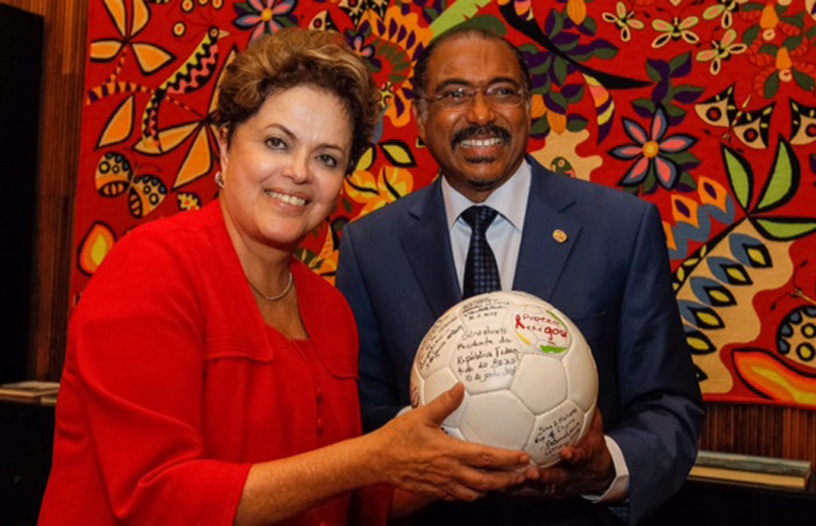
 At the Africa Cup of Nations in January 2013, UNAIDS presented their “Protect the Goal” Campaign, with goals of both preventing and raising awareness of HIV. HIV prevention information was posted on screens in the stadiums and prominent players backed the campaign by reading statements of support for this campaign before each game as they stood before their fans. With thousands of fans who look up to these teams and players, the campaign had a radically successful start [1]. A year and a half later, Protect the Goal has come to Brazil for the 2014 FIFA World Cup. Now backed by the President of Brazil, [2] Protect the Goal has been able to make an even greater impact, especially by offering free HIV tests to fans in Brazilian host cities. Renowned players like David Luiz are also joining the campaign and calling on their thousands of fans to join them in stopping the spread of HIV and stigma [3].
 Another organization, Grassroots Soccer, has taken a different approach to using soccer as a means of reducing HIV. They have built and refined a curriculum called “Skillz”, a new approach that uses soccer exercises to help kids learn about HIV risks and prevention.  For example, in one of their activities, called “Risk Field,” “participants dribble a soccer ball in between cones representing HIV-related risks—multiple partners, drug/alcohol abuse, sugar daddies, etc. If one player hits a cone, he and his teammates must complete 3 pushups, showing how the consequences of one person’s risk can not only affect him, but also his friends, family, and community" [4]. This is a revolutionary new way of educating kids, and allows the participants to feel more engaged in what they are learning.
Grassroots Soccer is using methods  that have proven results. One study in Zimbabwe found that, among many other encouraging statistics, students participating in the program who knew where to go for problems related to HIV increased dramatically, from 47% to 76% [5]. Like the Protect the Goal campaign, Grassroots Soccer is backed by a number of well-known players, such as AlexSong, Oguchi Onyewu, Christen Press, and more, [6] and is therefore able to reach a wide audience of fans that look up to and respect these players.


As evident by the campaigns and programs above, it is undeniable that sports have a great influence and can be used to unite and educate groups of people. Nelson Mandela said it best, “Sport has the power to change the world. It has the power to inspire. It has the power to unite people in a way that little else does. It speaks to youth in a language they understand. Sport can create hope where once there was only despair.” Soccer is more than just a game; it’s a powerful tool that can bring motivation, solutions, and hope to people around the world working to end HIV and the associated stigma and discrimination.


References:


Tuesday, June 3, 2014

Orange, Fuzzy, Feisty, and HIV-Positive: Meet Kami

By: Adriana Ganci

Since its premiere on public television in 1969, Sesame Street has been a keystone program in teaching children about diversity and acceptance. The show has historically depicted people of different ethnicities, nationalities, religions and abilities. Sesame Street is, in fact, where many children begin their educational journeys. Big Bird and Elmo are household names. But how many Americans have heard of the Muppet, Kami? Chances are, not many. But everyone should.

Kami is a character who originated on South Africa’s Takalani Sesame in 2002. She has a feisty spirit and loves the outdoors and playing soccer. She is also HIV-positive. In a country where 5.5 million people are living with HIV, the social impact of this issue on children is not one that can be ignored. Because the show is aimed at little tykes aged three-seven, the goal of this programming is not to teach about the importance of protected sex or about the dangers of sharing intravenous needles. The goal, instead, is to portray the life of Kami in a way that resembles the lives of hundreds of thousands of children in South Africa – the life of a child who loves to have fun, the life of a child who lives with HIV, and the life of a child whose parent died as a result of having AIDS. For too long there has been a culture of stigma and silence regarding this globally pervasive issue. Kami seeks to reduce this HIV-related stigma by exposing children to a friendly, likeable, and relatable character from a very young age.

How exactly does Kami work to fight against stigma? She loves playing the train game where everyone holds each other’s shoulders and pretends they are a train. In sharing this game – which, of course, involves physically touching your friends – Kami teaches us that playing games and giving hugs and high fives cannot transfer HIV. Kami also has a memory box that her mother left her before she passed away, filled with happy mementos like pictures of the two of them and her mom’s favorite scarf. Grieving is a very important process for children who lose parents, and Kami teaches us that, while the process is very difficult, evoking happy memories is a very good way to cope. When Kami isn’t singing about keeping the earth clean or kicking a soccer ball around, she is talking with the likes of Archbishop Desmond Tutu and Former President Bill Clinton, and thanking them for the work they’ve done for children like herself living with HIV. Both men have told Kami that she is the real hero. Kami’s accolade doesn’t end there – UNICEF also named Kami a “Champion of Children” in 2003. [1]

Kami was created by Sesame Workshop, the nonprofit organization behind the 45 years of work that Sesame Street has done to acknowledge key critical educational needs in the now 150 countries in which the show airs. [2] Sesame Workshop brings in experts to consult on creative ways to relay these important lessons to children. Projects by Sesame Workshop include an entire array of academic, social and emotional topics: they run the gamut from introducing a Muppet whose father is in prison to airing episodes discussing the importance of improving the education of girls worldwide.


Each project includes extensive post-production research on the actual educational impacts of the programs. Through this research, Sesame Workshop discovered that parents who have seen Kami on television are twice as likely to talk to their children about HIV and AIDS than parents who do not know Kami. Sesame Workshop has also concluded that since the introduction of Kami into the cast, children exposed to Takalani Sesame have demonstrated measurable increases in their knowledge of HIV, de-stigmatization of HIV, and the ability to cope with illness. [3] Due to Kami’s success in South Africa, producers who were creating Nigeria’s Sesame Square decided to also use Kami with the show’s launch in 2010.With nearly 278,000 children in Nigeria living with HIV, there was a need for a character like Kami. Bearing in mind that only about a quarter of Nigerian households have a television, the show’s creators have also created a campaign that extends to radio, cell phones, publications and school materials. [4]

When a person is able to closely identify with something like HIV they are generally able to understand it better. It also makes good sense that we, as humans, are less fearful, and thus less stigmatizing, of things we clearly understand.  Thus, using someone who is vibrant, young, and fun-loving like Kami to introduce the subject of HIV to children of a young age helps to reinforce the idea that those living with HIV are people just like those not living with HIV. Aiming these lessons at children will help South Africa and Nigeria to end the culture of silence and stigma surrounding HIV which, in turn, has the potential to lower the infection rates in those countries. Kami has the potential to help the next generation of South African children become the most accepting generation yet. This is fitting since “Kami” is the Setswana word for “acceptance”.

When Kami joined Takalani Sesame in 2002, some conservative legislators in the U.S. sent a letter to PBS stating that if PBS were to utilize the HIV-positive character in the American show, their funding would be threatened. [5] American children have come to love Muppets who are in wheelchairs, Muppets who are blind, Muppets who are different colors and those that practice different faiths. Hiding the idea of HIV from children will only continue to feed ignorance and fear and encourage stigma towards those living with HIV for years to come. There is no reason that American children would not come to adore Kami, just as others did in South Africa and Nigeria. With a name that literally means “acceptance”, it sounds like it is definitely time to make Kami a household American name.

1.  http://www.unicef.org/media/media_16631.htm
2. http://www.sesameworkshop.org/what-we-do/our-research-model/
3. http://www.sesameworkshop.org/what-we-do/our-research-model/
4. http://www.cnn.com/2010/SHOWBIZ/TV/10/06/sesame.street.nigeria/
5. http://www.queerty.com/could-hiv-muppet-kami-ever-move-into-americas-sesame-street-20100104